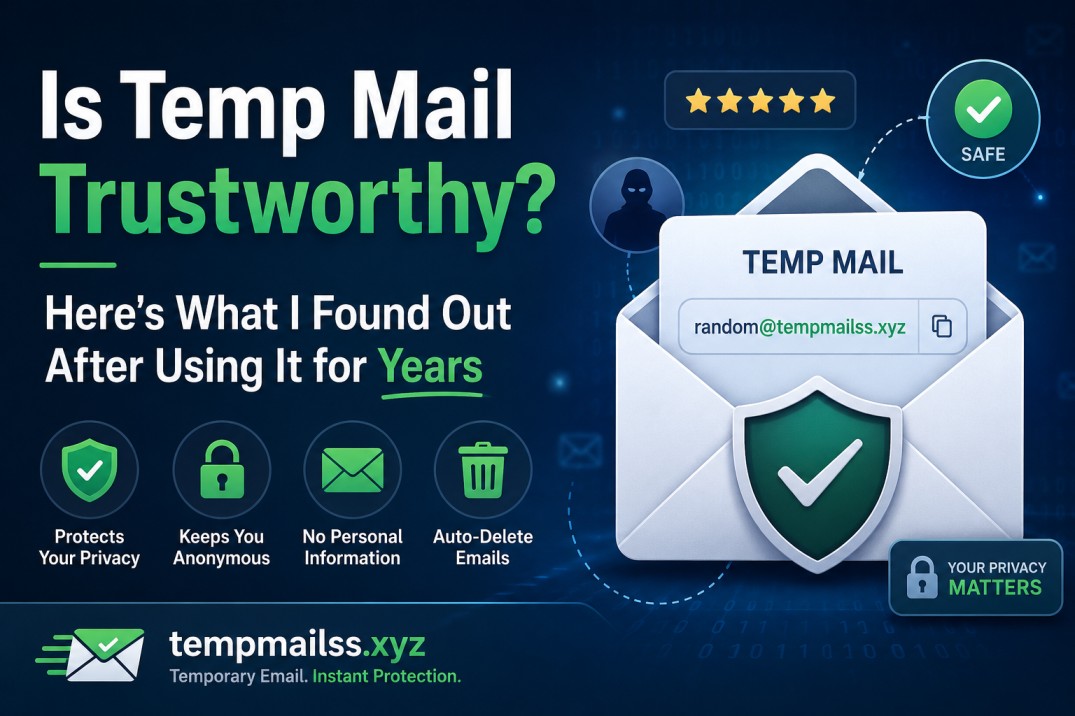
I'll be honest — the first time someone suggested I use a temp mail service, I hesitated.
My exact thought was: "So I'm supposed to trust some random website with my email activity?"
It felt backwards. I was trying to protect my privacy, and the solution being offered was to hand my inbox activity to yet another unknown service. That didn't sit right with me immediately.
But I kept seeing temp mail come up — in privacy forums, in developer communities, in Reddit threads about cutting down inbox spam. So I did what any mildly paranoid tech person does: I dug in, tested a few services, read about how they actually work, and slowly formed a real opinion.
Here's what I actually think after years of using temp mail regularly — the good parts, the legitimate concerns, and where the line is between "trustworthy tool" and “proceed with caution.”
The Trust Question Is Actually Two Different Questions
When people ask "is temp mail trustworthy," they're usually asking one of two very different things:
Question 1: Can I trust that the temp mail service itself won't do something shady with my data?
Question 2: Can I trust temp mail to protect me — my privacy, my security, my information?
These need separate answers because they're completely different concerns. Let's tackle both.
Can You Trust the Temp Mail Service Itself?
Short answer — it depends on which one you use, and what you're using it for.
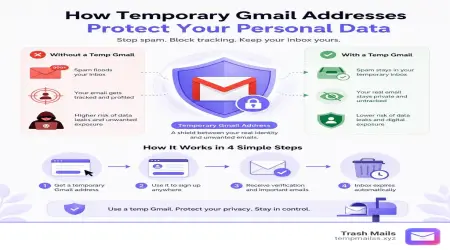
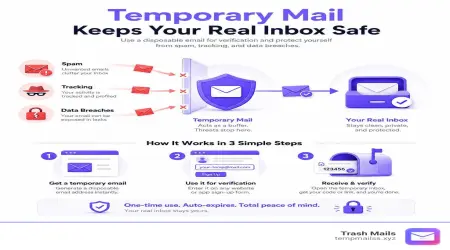
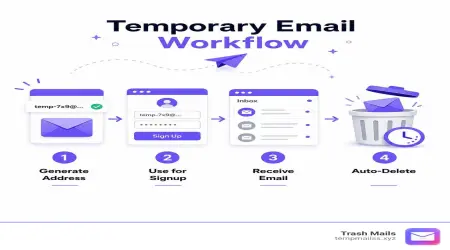
Here's the thing about how most temp mail services actually work: they're not asking you to "log in." There's no account. No password. No recovery email. You arrive at a site like tempmailss.xyz, and an inbox is already waiting for you. You didn't give anything to get it.
That changes the trust equation significantly.
Compare that to signing up for a new Gmail account. You're giving Google your phone number, possibly a recovery email, agreeing to their terms, and creating a profile that lives in their database forever. That's a much larger trust commitment than visiting a temp mail page.
With a decent temp mail service:
- You don't hand over your name
- You don't hand over your real email
- You don't create an account that stores your history
- The inbox expires after a set window and is gone
So in that sense? A good temp mail service asks less from you than most things you use online every single day.
That said — there are temp mail services out there that are genuinely bad. Some are ad-stuffed nightmares that track your every click. Some log the content of emails that pass through their servers. Some have shady ownership with zero transparency.
The service matters. And I'll get to how to spot the trustworthy ones vs. the sketchy ones in a bit.
Does Temp Mail Actually Protect You?
This is where people sometimes expect more than the tool is designed to deliver — and end up either disappointed or misusing it.
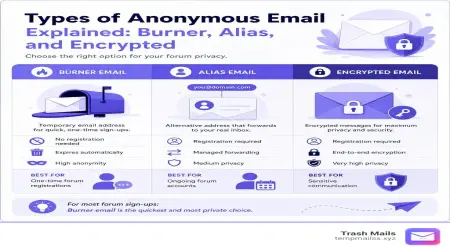
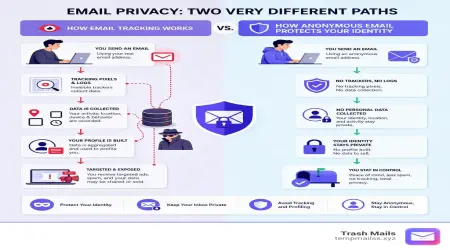
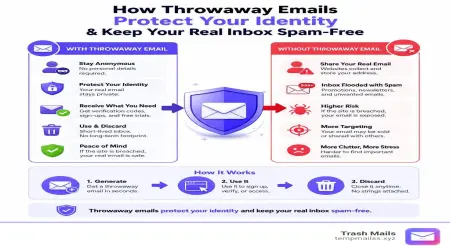
Temp mail does one specific job well: it keeps your real email address private from sites you don't fully trust.
That's it. That's the job.
It does NOT:
- Hide your IP address or location (you need a VPN for that)
- Encrypt your emails end-to-end (use ProtonMail for that)
- Make you fully anonymous online
- Protect passwords or payment information
I've seen people make the mistake of thinking temp mail = full privacy mode. It doesn't work that way. If you sign up for something with a temp mail address but use your real name, real credit card, and your home IP address — you're not particularly anonymous. The email was just one of many data points.
But for its actual purpose — keeping your real inbox clean and preventing email harvesting — it genuinely works. I've signed up for probably 50+ random services using temp mail over the years. My primary Gmail stays clean. That alone is worth a lot.
What Makes a Temp Mail Service Actually Trustworthy?
Not all temp mail services are created equal. Here's what I look for after trying several of them.
Clear about what it does and doesn't do. A trustworthy temp mail site doesn't overpromise. It doesn't claim to make you "completely invisible" or "100% anonymous." Those are red flags — either the site is naive or it's trying to attract users it shouldn't be attracting.
No unnecessary data collection. Does the site ask you to create an account? Does it require a phone number? Are there a suspicious number of trackers loading in the background? These are signs the service cares more about harvesting your data than protecting it.
Reasonable inbox lifetime. Good temp mail services are upfront about how long your inbox sticks around — whether that's 10 minutes, an hour, or a day. The ephemeral nature is a feature, not a bug. A site that keeps inboxes forever isn't really "temporary."
Straightforward interface. Honestly? The sketchiest temp mail sites I've tried were the ones loaded with misleading buttons, fake "download" prompts, and pop-ups trying to get you to install browser extensions. A clean, simple interface is a decent signal of a legitimate operation.
Recognizable reputation in the privacy community. Sites that show up in recommendations on privacy-focused forums like r/privacy, r/degoogle, or privacy-focused tech blogs tend to be the safer picks. They've been vetted by people who care about this stuff.
Tempmailss.xyz falls into the "clean and straightforward" category — you arrive, you get an address, you use it. No account, no setup, no nonsense.
Real Situations Where Temp Mail Is Absolutely Trustworthy to Use
Let me give you concrete scenarios from my own experience where temp mail was the right call and worked exactly as expected.
Downloading a free resource behind a form wall. Marketing agencies, SaaS companies, and bloggers all do this — they put a form in front of PDFs, templates, and toolkits. You want the resource, not the nurture email sequence that follows for the next six months. Temp mail gets you through the gate cleanly.
Signing up for a one-time webinar or event. You want the Zoom link. You don't want to be on their mailing list for the next three years. Temp mail is perfect for this.
Testing app signup flows as a developer or QA tester. This is probably the most "professional" use case. When you're building or testing a product, you need real email addresses for testing without spamming your team's inboxes. Temp mail handles this effortlessly.
Trying out a new tool or software you're not committed to. I've done this with dozens of project management tools, AI writing assistants, and design apps. Use temp mail for the trial, and if you like it enough to commit, sign up with your real email for the paid version.
Getting a discount or first-time-buyer coupon. Some sites offer 10-15% off for email signups. You get the coupon code in the temp mail inbox. You use it. Done.
Situations Where You Should NOT Use Temp Mail
This matters just as much, and I want to be straight with you.
Any account you actually plan to keep using. If you're signing up for a platform you'll return to regularly — your bank, your cloud storage, your primary social media — use a real, permanent email. If you ever get locked out and need account recovery, a temp address that no longer exists won't help you. I learned this the hard way with a productivity tool I actually liked. Gone. No recovery possible.
Healthcare, legal, or financial communication. Just... no. Temp mail inboxes are not private. Anyone with your temp address could theoretically read your emails. Never use it where confidentiality actually matters.
Anything that requires verified identity. Government services, verified financial platforms, KYC (know your customer) processes — these exist for legal reasons. Using temp mail to sidestep them isn't just ineffective, it can get your account flagged or permanently banned.
Two-factor authentication you'll need later. If a service sends 2FA codes to your email and you used a temp address, you're eventually going to lock yourself out. Use your real email for anything where you need persistent 2FA.
A Quick Word on the "Anyone Can Read Your Emails" Concern
This comes up a lot, and it's a fair concern to raise.
Most temp mail services do not have any authentication on inboxes. If someone knew your exact temp email address — like qr94x@tempmailss.xyz — they could theoretically visit that inbox and read what's there.
In practice, this is almost never an issue because:
- The address is randomly generated and hard to guess
- The inbox expires quickly anyway
- There's nothing particularly sensitive in a confirmation email or download link
But it's worth knowing. Don't treat temp mail like a private, encrypted channel. It's more like a disposable sticky note. Works great for its purpose, not meant to hold secrets.
How to Use Temp Mail Safely (My Personal Approach)
After years of doing this, here's the exact mental checklist I run through before deciding whether to use a temp address:
Will I need this account again? → If yes, use my real email.
Does this involve money, health, or legal stuff? → Real email, always.
Am I just grabbing a free resource or trying a tool? → Temp mail, no question.
Does this site look sketchy overall? → Temp mail and I'm using a VPN.
Is this a one-time event with a time-limited link? → Temp mail, and I'm checking it immediately.
That's it. It takes about three seconds to decide, and it keeps my approach consistent.
The Bottom Line
Temp mail isn't perfect, and pretending otherwise would be dishonest.
But for what it's actually built to do — giving you a throwaway inbox so your real email stays private — it works reliably and well. The trust question really comes down to choosing a reputable service, understanding the tool's actual limits, and using it for the right situations.
Think of it less like a privacy cloak and more like a clean pair of disposable gloves. Great for the messy jobs. Not a replacement for a full protective suit.
Used correctly, temp mail is one of the most practical, low-effort ways to keep your digital life a little cleaner and a little quieter. And after years of watching my spam folder fill up from a single moment of inbox carelessness — that's something I genuinely value.
Give tempmailss.xyz a try the next time a site wants your email before letting you through. You might be surprised how freeing it feels to just... not hand that over.
Got a specific situation you're not sure about? Drop it in the comments and I'll give you my honest take on whether temp mail is the right move.